
How to Read a Tire Sidewall: Size, Load Index & Speed Rating (2027 Guide)
Tire Sidewall: Size, Load Index & Speed Rating
- Understanding The Numbers
- Different Tire Size Systems
- Understanding Load Index Value
- Purpose Of Speed Rating
- Balancing Speed Rating
TL;DR: A tire sidewall code like 225/60R17 99H packs in five specs: section width (225mm), aspect ratio (60% sidewall height), rim diameter (17″), load index (99 = 1,709 lbs max), and speed rating (H = 130 mph max). Match your vehicle’s door-jamb placard on all five never guess, and never go lower on load index or speed rating than the original spec.
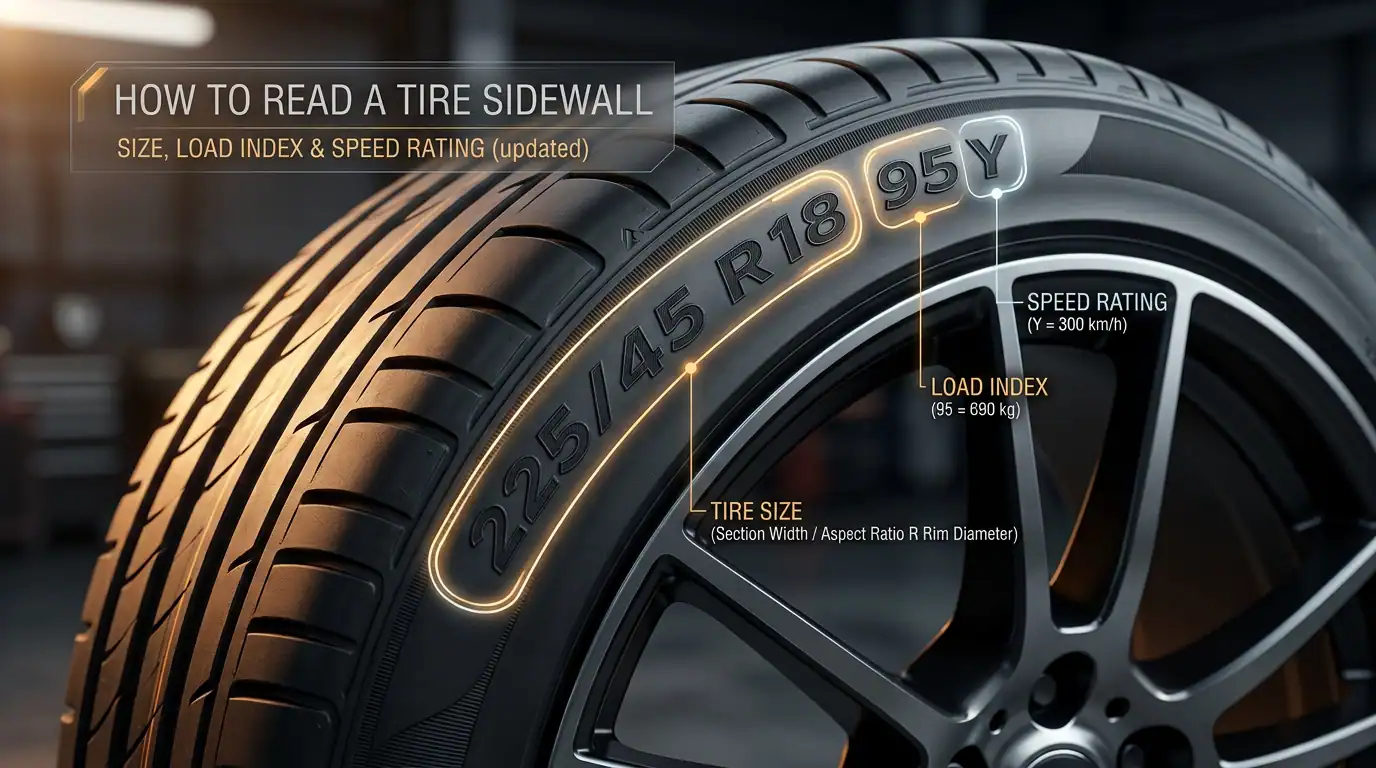
If you’ve ever crouched next to your car and stared at a code like 225/60R17 99H stamped into the rubber, you already know the feeling: it looks like a password, not a spec sheet. But once you know how to read a tire sidewall, that code tells you almost everything a tire shop needs to know before they mount a replacement the width, the height, the wheel fit, how much weight it can carry, and how fast it’s built to run.
This guide walks through tire size, load index, and speed rating piece by piece, explains how the three work together, and flags one change reshaping the load index conversation heading into 2027: the new HL (High Load) rating built for heavier EVs. By the end, you’ll be able to read any sidewall cold and know exactly what to ask for at the counter.
What Does the Code on a Tire Sidewall Mean?
A tire sidewall code encodes five specs in one string: section width in millimeters, aspect ratio as a percentage, rim diameter in inches, load index as a weight-capacity number, and speed rating as a letter. Using 225/60R17 99H as the example:
| Code segment | What it means | This example |
| 225 | Section width in millimeters | 225mm wide |
| 60 | Aspect ratio sidewall height as % of width | Sidewall is 60% of 225mm |
| R | Radial construction | Standard on nearly all passenger tires |
| 17 | Rim diameter in inches | Fits a 17-inch wheel |
| 99 | Load index max weight per tire | 1,709 lbs per tire |
| H | Speed rating max sustained speed | Up to 130 mph |

Why Does the Tire Sidewall Code Matter?
The tire sidewall code matters because size, load index, and speed rating are a matched engineering set, not three independent numbers a mismatch in any one of them changes how the vehicle actually behaves. A tire that’s the wrong width shifts the contact patch and cornering grip. A tire under-rated for weight runs hotter and closer to structural failure every mile it’s loaded. and tire rated below the vehicle’s design speed loses its safety margin exactly when you need it most, on a hot highway with a full trunk.
That’s the lens to read this guide through. We’ll go deeper than the sidewall code itself into the systems behind it: how tire sizing standards differ across vehicle types, what actually happens to a tire’s load capacity when pressure drops, why mixing tire sizes on an all-wheel-drive vehicle can be an expensive mistake, and what’s changed in the load index conversation for 2026 as EVs get heavier.
How Do You Read a Tire Size Code?
A tire size code is read left to right as: section width in millimeters, aspect ratio as a percentage, construction type, and rim diameter in inches. A modern passenger tire size follows a P-metric or Euro-metric format (P225/60R17 or 225/60R17), and each segment has a distinct job:
- Section width (225): the tire’s width in millimeters, measured sidewall to sidewall. A wider tire generally means a larger contact patch and more cornering grip, at some cost to fuel efficiency and road noise.
- Aspect ratio (60): the sidewall’s height as a percentage of the section width. A “60” here means the sidewall is 60% as tall as the tire is wide lower numbers (40, 35, 30) mean a shorter, stiffer sidewall typical of performance tires; higher numbers (65, 70, 75) mean a taller, more cushioned sidewall typical of comfort-oriented tires.
- Construction (R): R stands for radial, the internal belt construction used on virtually every tire sold today. You may occasionally see “D” (diagonal/bias-ply) on trailer or specialty tires, but it’s rare on passenger vehicles.
- Rim diameter (17): the wheel diameter, in inches, the tire is built to mount on. This must match your wheel exactly there’s no “close enough” here.
You’ll also see LT (Light Truck) prefixes on tires built for towing and hauling, which use a different, more conservative load-rating system (covered below), and T (Temporary) on space-saver spares.
Most certainly. There’s rather a lot of car here – the Dawn is 5.3 metres long, 1.9 metres wide.
Getting the tire size code right matters more than most drivers realize. Swap in a size with a different overall diameter and you throw off your speedometer accuracy, your effective gearing, your ground clearance, and on many newer vehicles the calibration of ABS and traction control, since those systems assume a specific wheel-rotation-to-speed relationship.

What Are the Different Tire Sizing Systems?
Passenger vehicles use five main tire sizing systems P-metric, Euro-metric, LT-metric, alpha-numeric, and T-type and mixing them up is a common source of confusion at the tire counter:
- P-metric (P225/60R17): the “P” stands for passenger, and this is the most common format on sedans, coupes, and many crossovers sold in North America. P-metric load capacities are calculated slightly differently than Euro-metric sizes of the identical dimensions, which is why two tires with the same numbers can carry marginally different rated loads depending on which standard they were built to.
- Euro-metric (225/60R17, no leading letter): functionally almost identical to P-metric in dimension, but built to European load-index tables. On most vehicles the difference is negligible, but it’s worth knowing the two aren’t always perfectly interchangeable on load-sensitive applications.
- LT-metric (LT245/75R17): “LT” stands for Light Truck, used on three-quarter-ton and larger pickups, cargo vans, and vehicles regularly used for towing or hauling. LT tires use the Load Range system (C, D, E, F detailed below) instead of the SL/XL/HL system, and they’re built with heavier internal plies to handle sustained heavy loads at higher inflation pressures.
- Alpha-numeric (older sizing, e.g. FR78-15): largely phased out of new-tire production but still occasionally seen on classic and specialty vehicles. If your vehicle calls for an alpha-numeric size, a tire professional can convert it to a modern equivalent.
- T-type (T125/70D16): temporary spare tires (“space savers”), rated for limited speed and distance only never treated as a full-time replacement tire.
These sizing conventions are standardized in North America by the Tire and Rim Association (T&RA) and internationally by the European Tyre and Rim Technical Organisation (ETRTO), the two bodies that publish the load and dimension tables tire manufacturers build to.
Where Can You Find Your Vehicle’s Correct Tire Size?
The single most reliable source for your vehicle’s correct tire size, load index, and speed rating is the manufacturer’s placard, not the tire currently mounted on your car. It’s usually located on the driver’s-side door jamb (open the door and look at the frame, not the door itself); some older vehicles place it in the glovebox, on the fuel door, or in the owner’s manual instead. This placard reflects what the manufacturer engineered the vehicle around, whereas the tire currently on the car may have been swapped, mismatched, or downgraded by a previous owner at some point in its life. The NHTSA’s tire safety guidance confirms the door-jamb placard not the tire sidewall as the authoritative source for a vehicle’s correct specs.
How Does Aspect Ratio Change the Way a Car Drives?
Aspect ratio changes ride comfort versus steering sharpness: a taller sidewall (higher aspect ratio) absorbs more impact for a plusher ride, while a shorter sidewall (lower aspect ratio) flexes less for sharper cornering response. A taller sidewall (a higher aspect ratio, like 65 or 70) has more rubber and air volume to flex and absorb impacts before that energy reaches the wheel and suspension which is why comfort-oriented sedans and minivans tend to run tall, narrow-ish tires. A shorter sidewall (a lower aspect ratio, like 35 or 40) flexes less under cornering load, which sharpens steering response and reduces the “vague” feeling some drivers notice in tall-sidewall setups but it also transmits more road impact directly into the cabin and is more vulnerable to sidewall damage from potholes and curbs, since there’s less cushion of air and rubber to absorb the hit.
This is also the number most affected by plus-sizing the practice of moving to a larger-diameter wheel while keeping the overall tire diameter roughly constant. Going from a 60-series to a 45-series tire on a larger wheel (a “17-to-19 plus-two” setup, for example) trades ride comfort for cornering sharpness and visual stance, without necessarily changing your effective gearing or speedometer accuracy provided the overall diameter is kept within tolerance, covered in the checklist below.
What Is a Tire Load Index, and How Much Weight Can It Carry?
A tire’s load index is a two- or three-digit number that maps to a maximum weight capacity per tire not per axle, and not per set as defined in standardized industry load tables. It’s one of the most commonly misread numbers on the sidewall, because drivers assume a higher number is just “extra durability” rather than a hard weight ceiling.
| Load Index | Max Load (lbs) | Max Load (kg) |
| 82 | 1,047 | 475 |
| 85 | 1,135 | 515 |
| 88 | 1,235 | 560 |
| 91 | 1,356 | 615 |
| 95 | 1,521 | 690 |
| 99 | 1,709 | 775 |
| 102 | 1,874 | 850 |
| 105 | 2,039 | 925 |
| 109 | 2,271 | 1,030 |
The rule that matters: never go below the load index specified on your vehicle’s tire placard (the sticker on the driver’s door jamb not whatever was on the tire you’re replacing, which may have been mismatched by a previous owner). Going higher than the minimum is generally safe and is common practice for SUV and truck owners who tow or haul regularly.
How Are Tire Load Index Ratings Determined?
Load index ratings come from standardized industry load tables published by the Tire and Rim Association and ETRTO, and each tire is rated for its maximum load at its maximum rated inflation pressure not at any pressure. That’s the detail most drivers miss. The load index printed on the sidewall is not a fixed weight the tire can always carry it’s the weight the tire can carry when inflated to the pressure the tire itself specifies, which is usually printed right next to the load index on the same sidewall (and is not necessarily the same number as your vehicle placard’s recommended pressure).
Understanding tire size, load index, and speed rating is crucial for optimal performance and safety
This is why underinflation is a load-capacity problem, not just a wear problem. A tire rated for 1,709 lbs at 44 psi (its max sidewall pressure) is not actually carrying 1,709 lbs safely at 30 psi the sidewall flexes more than designed, generates more heat, and the tire’s real-world capacity drops below its printed rating. If you’re running close to a vehicle’s maximum load a fully loaded SUV on a road trip, a truck near its payload limit checking pressure against the load, not just the door placard’s default number, is worth five minutes before you leave.
What Do SL, XL, and HL Mean on a Tire?
SL (Standard Load), XL (Extra Load), and HL (High Load) are letter codes marking a tire’s internal construction and the inflation pressure it needs to reach its full rated capacity not just a size or durability label:
- SL (Standard Load): the baseline construction, reaches its rated load index at a standard reference pressure (typically 35–36 psi).
- XL (Extra Load): reinforced internal construction that carries more weight than an SL tire of the same physical size, but requires higher inflation pressure to hit its full rated capacity.
- HL (High Load): a newer designation, increasingly common on tires spec’d for heavier battery-electric vehicles. HL tires are certified at an even higher reference pressure than XL, letting the same tire size carry meaningfully more weight without moving to a larger, heavier wheel-and-tire package.
The HL rating exists because EV battery packs routinely add 1,000+ pounds over a comparably sized gas vehicle, and that extra mass has to ride on tires not on the frame. If your EV came from the factory with HL-rated tires, replacements should also be HL-rated; dropping to SL or even XL tires that “look like the right size” can leave the tires structurally undersized for the vehicle’s actual weight, which accelerates wear and raises blowout risk.
Load Range letters (B, C, D, E, F)
appear on LT (Light Truck) tires instead of the SL/XL/HL system, and correspond to a maximum inflation pressure at which the tire hits its full rated capacity:
| Load Range | Max Pressure (psi) | Typical Use |
| B | 35 | Light-duty trailers |
| C | 50 | Half-ton pickups, light towing |
| D | 65 | Three-quarter-ton pickups, moderate towing |
| E | 80 | One-ton pickups, heavy towing/hauling |
| F | 95 | Commercial and heavy-duty applications |
If your vehicle came with LT tires, don’t substitute a same-size P-metric passenger tire without checking your owner’s manual first the load capacity isn’t equivalent even when the size numbers match. P-metric and LT-metric tires of the identical width, aspect ratio, and rim diameter are built on different internal-ply structures and rated to different pressure ceilings, so the printed size alone doesn’t guarantee interchangeability. As a rule of thumb, if your vehicle’s placard specifies LT tires and a Load Range letter, stay within that system when replacing them.
What Does a Tire’s Speed Rating Letter Mean?
A tire’s speed rating is the letter following the load index, and it indicates the maximum speed the tire is engineered to sustain but its real function is signaling heat tolerance and structural reinforcement, not just a top-speed limit.
| Speed Rating | Max Speed (mph) | Max Speed (km/h) | Typical Use |
| S | 112 | 180 | Economy sedans, minivans |
| T | 118 | 190 | Family sedans, crossovers |
| H | 130 | 210 | Sedans, EVs, crossovers |
| V | 149 | 240 | Sport sedans, performance crossovers |
| W | 168 | 270 | High-performance and luxury cars |
| Y | 186 | 300 | Ultra-high-performance and supercars |
Your replacement tires should match or exceed your vehicle manufacturer’s speed rating recommendation not because you plan to actually hit 130 or 149 mph, but because higher-rated tires are built with more heat-resistant compounds and stiffer internal structures that hold up better under sustained highway speeds, heavy loads, and hot pavement, even well below their rated maximum.
One shortcut we don’t recommend: downgrading your speed rating (say, from V to H) to save a few dollars per tire. Unlike some size substitutions, this one is tied directly to safety margin under heat and load, not just theoretical top speed a tire professional can tell you when a lower rating is genuinely appropriate (winter tires, for instance, are often intentionally rated lower than the vehicle’s summer tires).
Why Is Speed Rating Really About Heat, Not Just Speed?
Speed rating is fundamentally a heat-dissipation certification: as a tire rotates faster, the rubber compound flexes and releases heat far more rapidly than at low speeds, and the sidewall and belt package have to be engineered to dissipate that heat without the internal structure softening or separating. It’s a certification the tire can stay stable at that speed for a sustained period, not a suggestion about how fast you should drive.
That’s why a higher-rated tire tends to feel more composed during hard highway merges, mountain-pass driving in summer heat, or a fully loaded trip situations well under the tire’s rated maximum but still hotter and more demanding than city driving. It’s also why performance and EV manufacturers increasingly spec H- or V-rated tires even on trims that will never see a track, since the extra thermal margin pays off in everyday high-load, high-heat conditions.
What Speed Rating Does My Vehicle Type Need?
Speed rating needs scale with vehicle weight and performance intent economy cars typically need only S or T, while performance and luxury vehicles need V through Y for their heat and load margins:
| Vehicle Type | Typical OEM Speed Rating |
| Economy compact / subcompact | S or T |
| Mainstream sedan / crossover | H |
| Electric sedan or crossover | H or V (heavier weight demands more margin) |
| Sport sedan / performance crossover | V or W |
| Sports car / luxury performance | W or Y |
| Winter/snow tire (any vehicle) | Often Q, R, S, or T intentionally lower |
Winter tires are the clearest exception to “always match or exceed OEM speed rating.” Their softer, cold-weather compound trades outright speed capability for grip on ice and snow, and manufacturers rate them accordingly. Running a lower-speed-rated winter tire seasonally is standard practice and not a safety compromise, provided you’re not exceeding its rated speed on clear dry highways.
How Do Tire Size, Load Index, and Speed Rating Work Together?
Tire size, load index, and speed rating work together as a single engineered package, not three independent choices your vehicle manufacturer selected all three around a specific suspension, brake system, and weight distribution. A tire that’s the right size but the wrong load index is just as much of a mismatch as one that’s the wrong size entirely. A few real-world combinations for context:
| Tire Size | Load Index | Speed Rating |
| 185/65R15 | 88 | H |
| 205/55R16 | 91 | V |
| 225/50R17 | 94 | V |
| 235/45R18 | 94 | W |
| 245/45R19 | 102 XL | H |
| 265/40R21 | 105 HL | H |
Note the last two rows: as tires get larger and are increasingly fitted to heavier SUVs and EVs, XL and HL construction shows up more often even at speed ratings that aren’t especially aggressive the load requirement is driving the construction choice, not the speed requirement.
Why Are Mismatched Tires Riskier on AWD and 4WD Vehicles?
Mismatched tire diameters are riskier on AWD and 4WD vehicles because those drivetrains constantly compare wheel rotation speed to distribute power, and even a small mismatch can force the system to fight itself a problem two-wheel-drive vehicles simply don’t have. AWD systems constantly compare rotational speed across all four wheels to decide how to distribute power; even a small diameter mismatch (many manufacturers cite a threshold as low as roughly 2–3% difference in circumference) can make the system think one wheel is slipping when it isn’t, forcing the center differential or transfer case to work against itself continuously. Over months of driving, that low-grade fighting between wheels can wear out viscous couplings, clutch packs, or the transfer case itself a repair that costs dramatically more than a matched set of tires would have.
The practical takeaway: on AWD/4WD vehicles, replace tires in full sets of four whenever possible, and if you must replace just one or two, have the shop verify tread depth and diameter are close enough to stay within the manufacturer’s tolerance before it goes back on the road.
How Far Can You Plus-Size Tires Before It Causes Problems?
As a rule of thumb, keep the overall tire diameter within about 3% of the factory spec when plus-sizing wheels beyond that, speedometer accuracy and ABS/traction-control calibration start to drift. Plus-sizing moving to a larger wheel diameter while adjusting the tire’s aspect ratio to compensate is common for both looks and handling, but it only works safely within that narrow window. A free tire size calculator (widely available from tire manufacturers and retailers) will show you the overall diameter, revolutions per mile, and percentage difference for any size you’re considering against your factory size always run the numbers before ordering plus-sized tires, rather than eyeballing it.
Push much past that 3% window and several systems start drifting out of calibration at once: your speedometer will read a few percent off from actual speed, your odometer will accumulate mileage inaccurately (which matters for warranty tracking and resale), and on vehicles with electronic stability control, ABS, or adaptive cruise the onboard computer’s assumptions about wheel speed versus real-world speed can degrade the accuracy of those safety systems. None of this happens abruptly at exactly 3.1%; it’s a gradient, which is exactly why it’s easy to talk yourself into “just one size up” without noticing the cumulative effect.
What Maintenance Habits Protect Your Load Index and Speed Rating?
Five habits protect your tires’ rated load and speed capacity over time: monthly pressure checks, on-schedule rotation, watching wear patterns, inspecting sidewalls, and replacing by condition rather than tread depth alone. Buying the correct size, load index, and speed rating is only half the job day-to-day habits determine whether the tire actually performs to that rating over its lifespan:
- Check pressure monthly, and always before a heavy load. As covered above, load capacity is only valid at the tire’s rated pressure. A quality gauge is a better source of truth than “the tire looks fine.”
- Rotate on schedule (typically every 5,000–7,500 miles, sooner on EVs and single-axle-drive vehicles) to even out wear between drive and non-drive wheels.
- Watch for uneven wear patterns. Wear concentrated on the shoulders can indicate underinflation relative to load; wear down the center can indicate overinflation. Either pattern is worth a pressure check against your actual load, not just the default placard number.
- Inspect the sidewall itself, not just the tread bulges, cracks, or cuts near the tire sidewall compromise the structural reinforcement the load index and speed rating depend on, even if tread depth looks fine.
- Replace by condition, not just tread depth. A tire can reach the legal tread-depth minimum and still be structurally sound, or it can have plenty of tread left while sidewall aging (typically after 6–10 years regardless of mileage) has degraded the rubber compound the ratings were built around.
What Should Be on Your 2026 Tire-Buying Checklist?
- Find your OEM tire size, load index, and speed rating on the door jamb sticker not the tire you’re replacing, which may have been mismatched by a prior owner.
- Never buy below the OEM load index, and check for an SL/XL/HL or Load Range letter that matches or exceeds the original spec this matters especially for EVs and loaded SUVs.
- Match or exceed the OEM speed rating, unless a tire professional advises a specific exception for your use case (winter tires being the main one).
- If you’re plus-sizing wheels, use a tire size calculator to keep the overall diameter within about 3% of stock. Go beyond that and you’ll throw off speedometer accuracy and the calibration of ABS and traction control.
- Check that all four tires match in load index and speed rating mismatched sets can unbalance handling, and on AWD vehicles, mismatched overall diameters can damage the drivetrain over time.

FAQ
Can I put a higher load index tire on my car than the manufacturer specifies?
Yes. A higher load index than the OEM minimum is always safe. Going lower is not recommended under any circumstances.
What happens if I exceed my tire’s speed rating?
Heat builds up faster than the tire is designed to dissipate, which increases blowout risk especially on long highway stretches in hot weather or under a heavy load.
Do all four tires need the same load index and speed rating? Yes, in almost all cases. Mismatched tires can unbalance handling, and on AWD vehicles, mismatched sizes can put uneven stress on the drivetrain over time.
What’s the difference between XL and HL tires? Both are reinforced constructions that carry more weight than a Standard Load (SL) tire of the same size. HL (High Load) is the newer of the two, certified at a higher reference pressure than XL, and is increasingly the spec called out on heavier EVs.
Do electric vehicles need a different load index than gas cars? Often, yes. Because battery packs can add 1,000+ pounds to a vehicle’s weight, many EVs are spec’d with a higher load index and XL or HL construction than a similarly sized gas vehicle would need. Always match the door-jamb placard, not just the tire size.
How much can I change my tire size before it becomes a problem? As a rule of thumb, keep the overall tire diameter within about 3% of the factory size. Beyond that, speedometer readings, ABS calibration, and ground clearance can all be affected.
The Bottom Line
Once you can read a tire sidewall, the code on it stops being a mystery and starts being a checklist: confirm the size against your door placard, confirm the load index meets or beats the minimum (with an eye on SL/XL/HL if you’re on an EV or loaded SUV), and confirm the speed rating matches or exceeds spec. Get those three right and every other tire decision brand, tread pattern, price is just preference. Get one of them wrong, and it doesn’t matter how good the rest of the tire is.